Overview
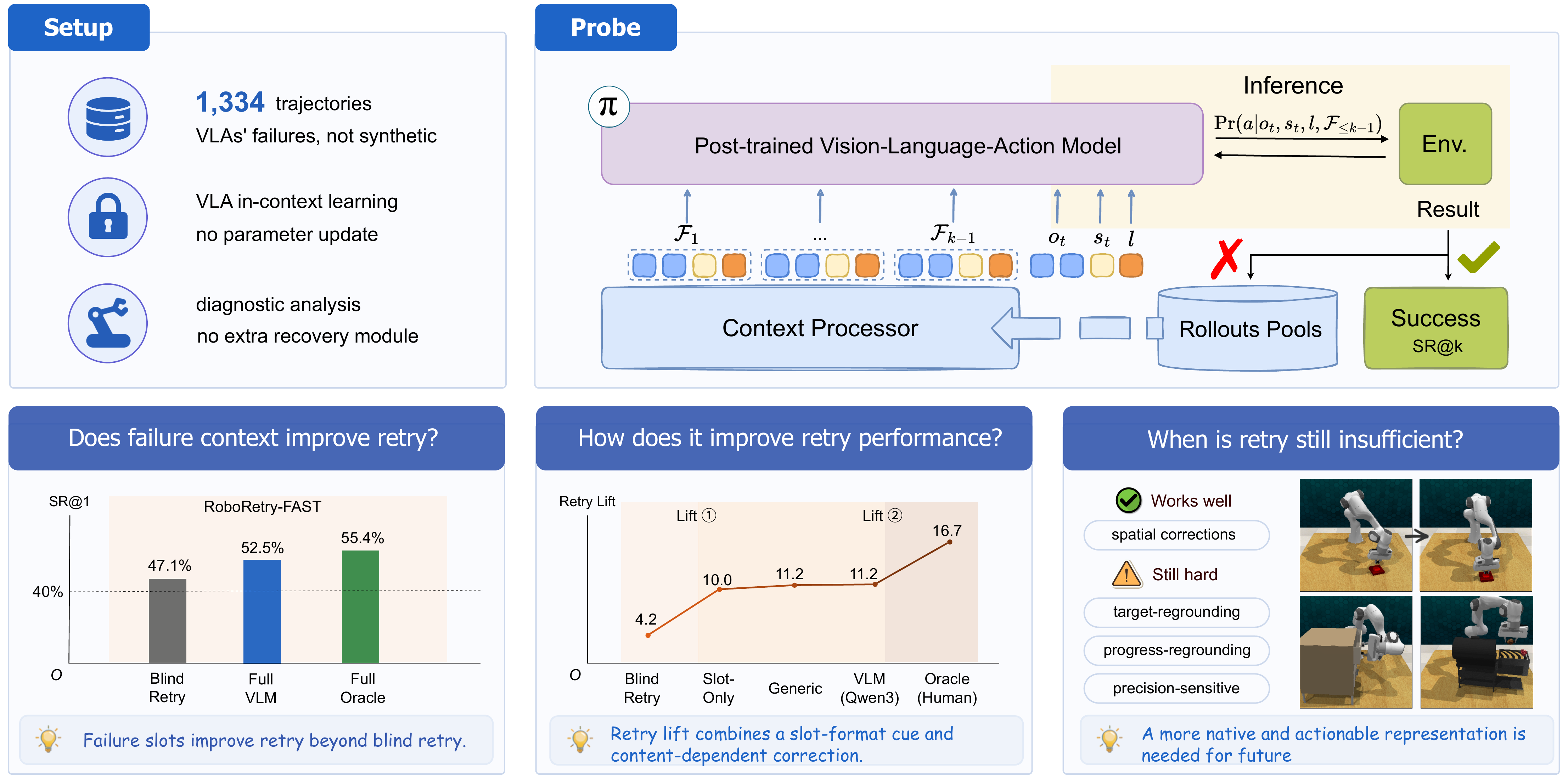
RoboRetry asks whether a VLA can use its own failed attempt as in-context evidence for a subsequent retry.
Vision-language-action (VLA) policies often repeat the same mistakes after failure, as they lack memory of prior attempts. Whether a VLA can learn from its own failure through in-context conditioning, and what information in failure contexts is useful, remains unclear. We study this with RoboRetry, a controlled probe that inserts failure information directly into the policy context window via block-diagonal attention. Across 12 RLBench tasks, we evaluate failure-conditioned retry under a paired protocol and compare it with success-demonstration context under the same retry budget. Our results show that failure-conditioned context improves cumulative retry success over matched blind retry.
Our interventions point to two sources of retry lift: a slot-presence effect that provides a structural retry cue, and a content-dependent effect driven primarily by high-quality corrective language. We further identify remaining limits around semantic target/progress re-grounding and contact-precision recovery, where free-form corrective text is not sufficiently actionable for the required recovery. To support further study, we release FailureSlot, a dataset of 1,334 naturally occurring VLA failure trajectories with human-labeled corrective annotations and an 8-category taxonomy. Together, the probe and dataset provide a starting point for studying failure-driven in-context robot learning, where adaptation happens through experience in context rather than through parameter updates.
RoboRetry asks whether a VLA can use its own failed attempt as in-context evidence for a subsequent retry.
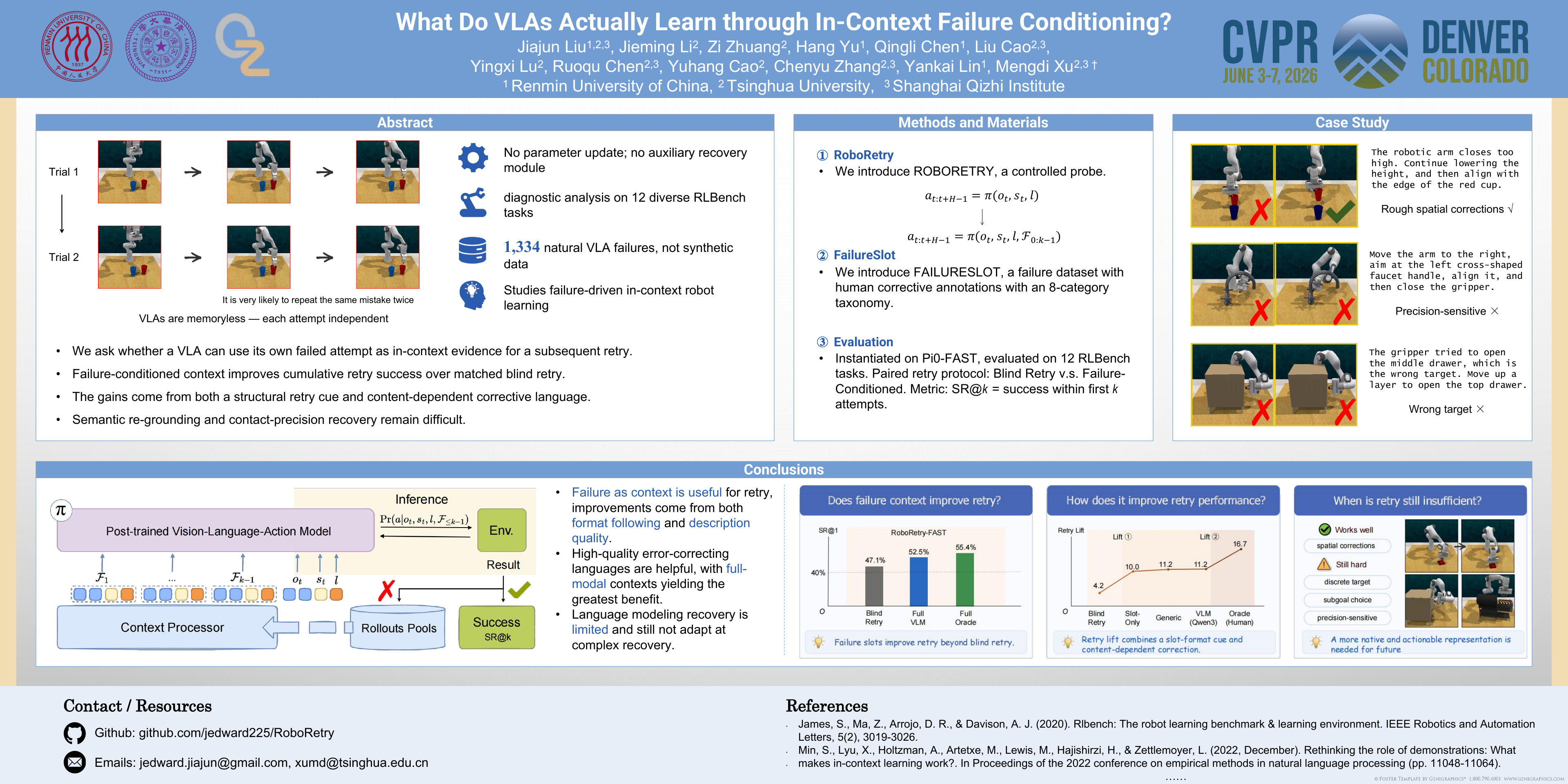
Click the poster preview or the Poster button above to open the PDF.
@misc{liu2026roboretry,
  title         = {What Do VLAs Actually Learn through In-Context Failure Conditioning?},
  author        = {Liu, Jiajun and Li, Jieming and Zhuang, Zi and Yu, Hang and Chen, Qingli and Cao, Liu and Lu, Yingxi and Chen, Ruoqu and Cao, Yuhang and Zhang, Chenyu and Lin, Yankai and Xu, Mengdi},
  year          = {2026},
  eprint        = {xxxx.xxxxx},
  archivePrefix = {arXiv},
  primaryClass  = {cs.RO},
  url           = {https://arxiv.org/abs/xxxx.xxxxx}
}